Why People See Different Things
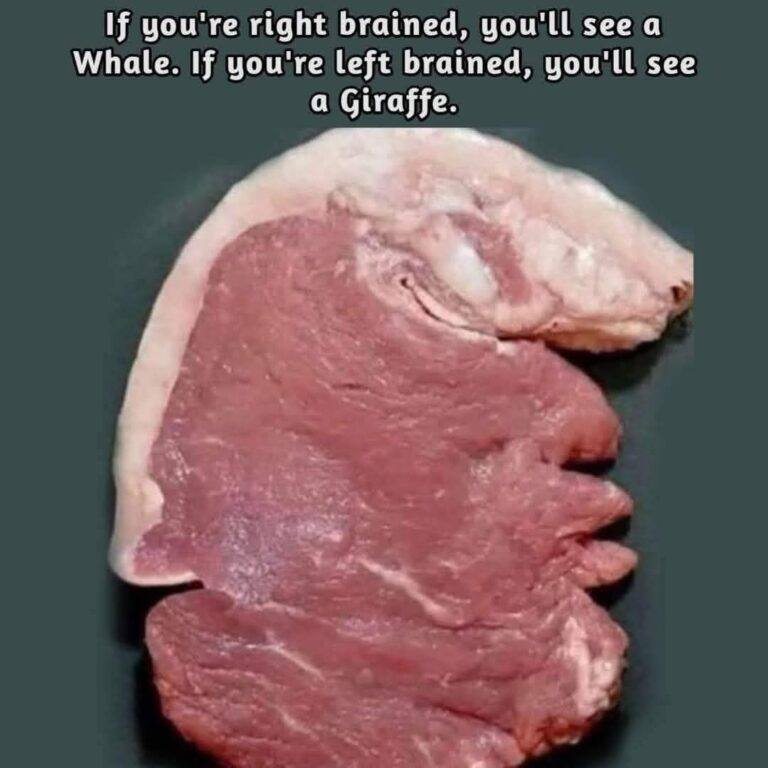
When you first look at the image, your brain automatically tries to connect the lines and shapes into something recognizable. Some people instantly see the rounded bulk and suggestive contour of a whale’s body, especially near the top of the meat where the fatty area seems to mimic a tail fin or blowhole.
Others are drawn to the shape of a giraffe’s head and long neck, especially on the bottom right where the contour looks like a mouth or snout. The illusion plays on suggestion. Once the idea is planted, it becomes hard to “unsee” it.
But here’s the truth: what you see first says less about which side of your brain dominates and more about how you’re wired to recognize certain patterns.
Debunking the Left vs. Right Brain Myth
The internet loves to categorize people into boxes: left-brained equals logical and analytical; right-brained equals creative and intuitive. While there’s some basis in brain hemisphere specialization, this idea is wildly oversimplified.
In reality, both hemispheres work together all the time. Whether you’re solving a math problem or drawing a picture, your whole brain gets involved. So, whether you see a whale or a giraffe doesn’t scientifically prove which side of your brain dominates—it simply shows how your brain uniquely interprets abstract visuals.
Common Mistakes People Make:
One of the most common mistakes when solving visual puzzles like this is jumping to conclusions too fast. Our brains are designed for speed. The moment we see something that feels familiar, we mentally “lock in” and stop questioning it.
Another issue is confirmation bias. Once someone tells you “it’s a whale,” that’s all you’ll see. You might even feel silly for not seeing it before. But that’s the beauty of illusions—they highlight how flexible (and sometimes unreliable) our perception really is.
Continued on next page//
For Complete Cooking STEPS Please Head On Over To Next Page Or Open button (>) and don’t forget to SHARE with your Facebook friends.